

In 2025, we joined Magnetawan First Nation to help scale up work they have been doing since 2018. Through this partnership, the Kinship Program: Wildlife, People, and Place, we are working together to create positive impacts for Ontario’s at-risk turtles (mishiikenyag).
In mid-June, Donnell Gasbarrini, Program Manager, Eastern Canada at the Wilder Institute, and Allison Scovil, Conservation Linkage Associate at the Wilder Institute, joined the Magnetawan First Nation team as they collected turtle eggs (mikinaakwaawan) for the head-starting program. Over the following two months, those eggs incubated, leading up to turtle release day on August 18th.
We sat down with Allison after her visit to learn more about the turtles’ journey to release day and the work that happens behind the scenes. She started by sharing more about her role:
We’re a fairly large organization with more than 250 staff and about 500 volunteers. Many of these individuals have their own audiences they connect with, from summer campers and daily visitors to members, partners, and many others.
My job is to help share what’s happening in Wilder Institute’s Applied Conservation programs so that everyone is equipped to tell those stories and share our work more broadly.
By joining our partners at Magnetawan First Nation (MFN) during field work for the Kinship Program, I was able to gain a deeper understanding of the program and the impact it’s having. That firsthand experience helps me share those stories more effectively with my colleagues.
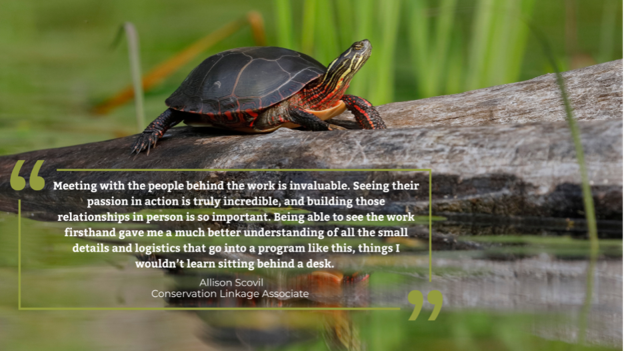
June in Ontario means turtle nesting season, a time when many female turtles leave the wetlands where they spend most of their lives in search of a good place to lay their eggs.
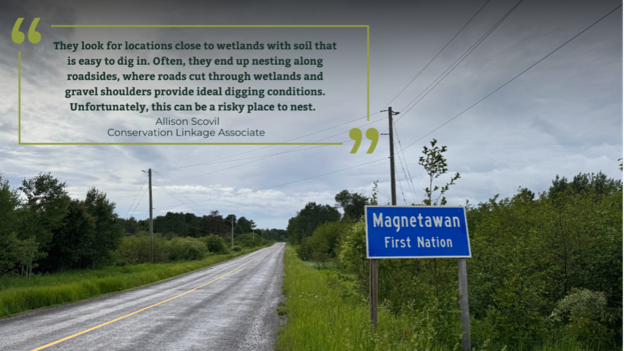
Beyond the significant hazards to the adult turtles themselves, nests along roads are easier for predators to find, as they are lined up along the shoulder with a clear path between them. Even if the eggs hatch successfully, the hatchlings begin life in a vulnerable location right next to a road.
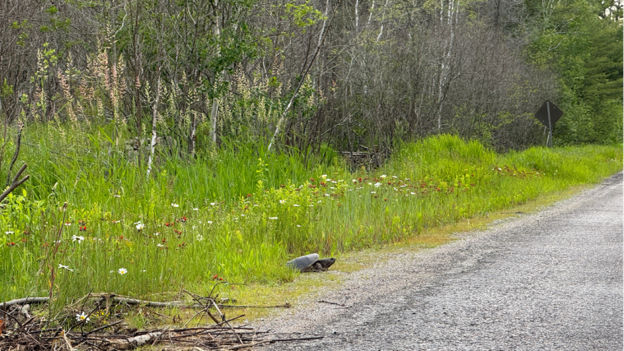
Caption: We spotted a snapping turtle nesting on the side of the road.
That’s why MFN started a head-starting program—to help turtle eggs through the most vulnerable stage of their life cycle. The team collects eggs that are considered at risk and care for them until they hatch, at which point the hatchlings are released back into wetlands close to where the eggs were originally found.
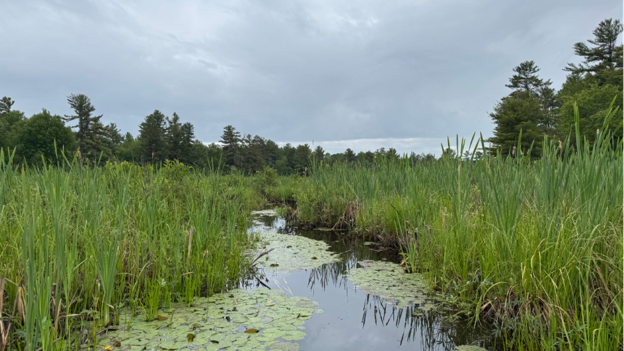
Caption: A wetland seen during turtle egg collection activities with the MFN team. This is habitat for at-risk turtles, the substrate adjacent to these locations make great nesting sites.
Many freshwater turtles nest at night or during the dusk and dawn hours, so the team’s workday often shifts into the evening and sometimes the early hours of the morning. Around 6p.m., we joined the MFN team to start the evening. To survey for nesting turtles, we slowly drove an approximately 20km stretch of road known for turtle nesting activity, and honestly, there was a lot of nesting activity!
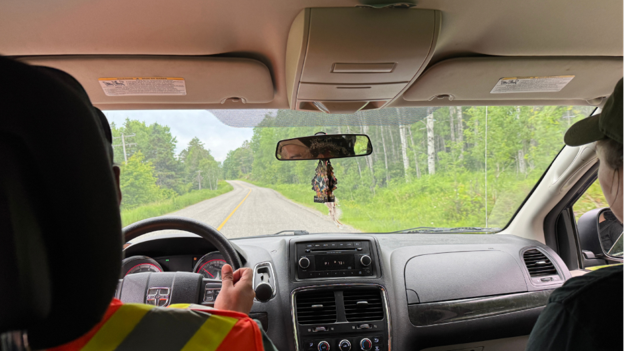
Caption: En route to turtle egg collection activities with the MFN team.
During the early part of the evening, we drove the route and took notes and GPS coordinates for any turtles we saw nesting. We were very careful not to disturb them, as we didn’t want them to abandon their nesting efforts. We would simply slow down, give them plenty of space, use a GPS unit to mark the approximate location, and continue on. At this time of year, we were seeing lots snapping and Blanding’s turtles on road shoulders to lay their eggs.
Blanding’s turtles have smooth, highly domed dark shells with tan-coloured flecks. They also have bright yellow chins and throats. Nadine Perron, Environmental Management Biologist for MFN summed up their description perfectly when she said to one turtle, “show us your sunshine!”
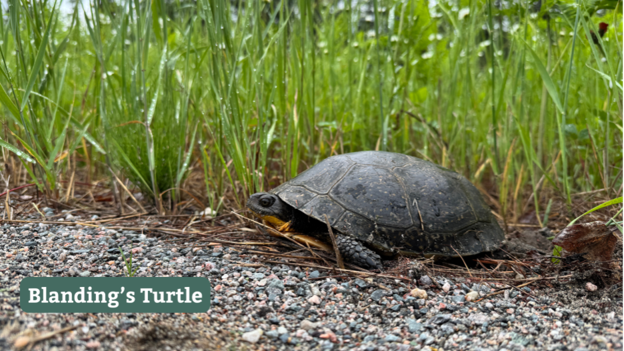
Caption: A Blanding’s turtle finishing nesting. She is using her back legs to cover and pat down the soil after laying her eggs. Seen during turtle egg collection activities with the MFN team. The eggs from this nest were collected for head-starting.
Snapping turtles on the other hand look very prehistoric! They have a flatter shell with serrated edges toward the back, a long tail with spikes reminiscent of a stegosaurus, and sturdy legs with webbed feet with long claws.
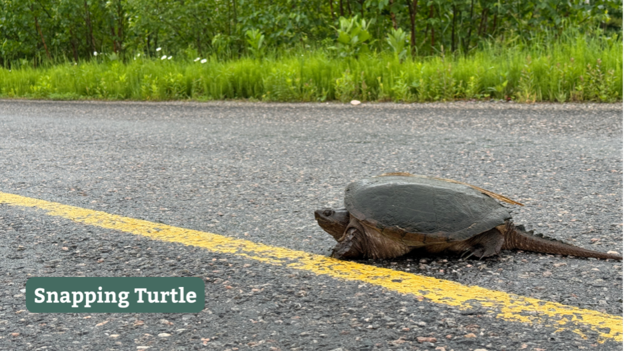
Caption: Snapping turtle on the road. Seen while out with the MFN Lands Department team searching for nesting turtles.
Over the following nights, the team would locate dozens more nesting turtles along this stretch of road, carefully excavating clutches by hand and bringing the eggs back for incubation under human care.
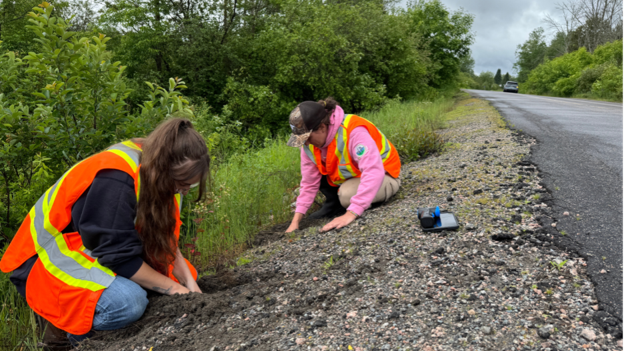
Caption: MFN Monitoring Technician, Megan Samuelsson, and Environmental Management Biologist, Nadine Perron, searching for snapping turtle eggs for head-starting.
We kept an eye on the locations of nesting turtles during our subsequent passes along the route. As soon as a turtle finished laying her eggs, we would pull over and begin searching for the nest. It usually didn’t take long because the fresh digging was still visible, although the nests are surprisingly well camouflaged.
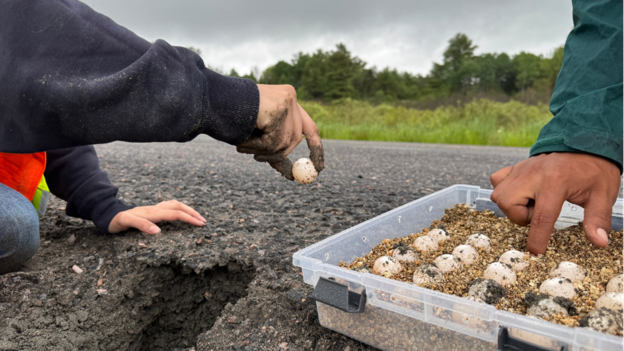
Caption: MFN Monitoring Technicians, Megan Samuelsson and Terry Jones, collecting snapping turtle eggs for head-starting.
Once the nesting site was located, the team carefully excavated it by hand. After finding the eggs, they gently removed them and placed them into containers filled with moistened vermiculite. The team is very careful not to rotate the eggs during this process. Each egg is placed in the substrate in the same orientation it was found because, once laid and incubation starts, the embryo attaches to the inside wall of the shell. Rotating an egg can damage or even kill the developing embryo. This is different from bird eggs which require regular turning during development.
Snapping turtles can lay between 25 and 45 eggs, and in some cases, even more! Their eggs are round and just slightly smaller than a ping-pong ball. Blanding’s turtles typically lay fewer eggs, usually 12 to 15, and their eggs are more oval-shaped.
Over the course of three nights, we collected clutches from multiple snapping and Blanding’s turtles, resulting in 170 eggs being brought in for the head-starting program, in just those 3 days! The largest clutch we encountered came from a snapping turtle nest, where we collected 37 eggs.
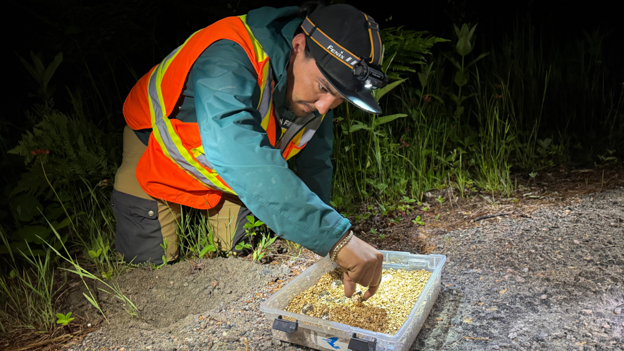
Caption: MFN Monitoring Technician, Terry Jones, collecting snapping turtle eggs for head-starting.
We also documented any predated nests we found. A predated nest is usually easy to identify because it has been dug up, and pieces of eggshell are scattered round the site. Turtle nests are highly vulnerable to predators such as racoons, skunks, crows, foxes, and other animals. Many of these predator populations are larger than they once were, and nests laid along roadsides can be especially easy to locate.
This is one-reason why the head-starting program is so important—it helps turtles through one of the most vulnerable periods of their lives. We did come across one nest that had been partially predated, and we were able to collect the remaining eggs.
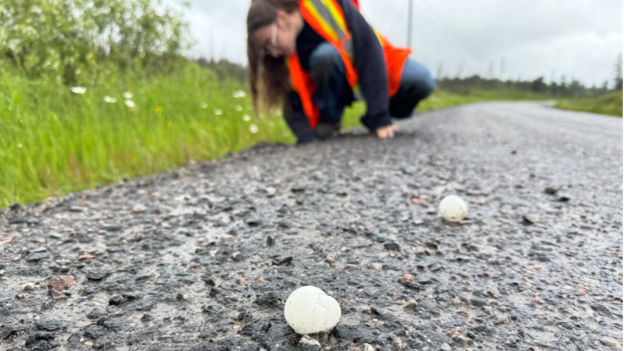
Caption: Partially predated snapping turtle nest. Monitoring Technician, Megan Samuelsson, collecting the rest of the eggs for head-starting.
The collected eggs are brought back to the MFN Lands Department office, where the incubation facilities are located. Each container is labelled and placed in an incubator, and a team member completes a full intake and documentation process the following morning. The eggs stay in these incubators until they hatch, anywhere from 60-90 days later. The team maintains the incubators at 28.5 degrees Celsius during the day, and 22 degrees Celsius at night, and ensures the vermiculite remains moist.
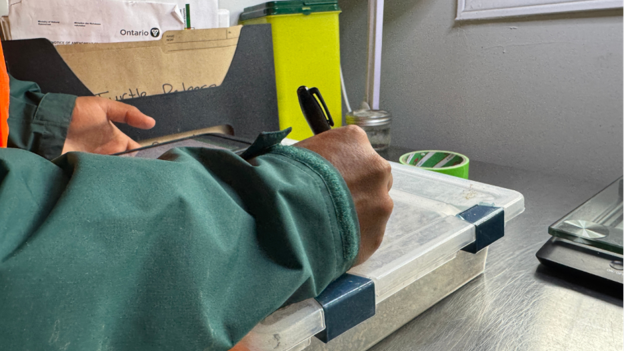
Caption: MFN Monitoring Technician, Terry Jones, labelling the collected eggs prior to placing them in the incubator.
Most turtle species found in Ontario have what’s called ‘temperature-dependent sex determination’. This means that the temperature at which the eggs are incubated determines the sex of the developing hatchlings. Higher temperatures tend to produce more females while lower temperatures tend to produce more males.
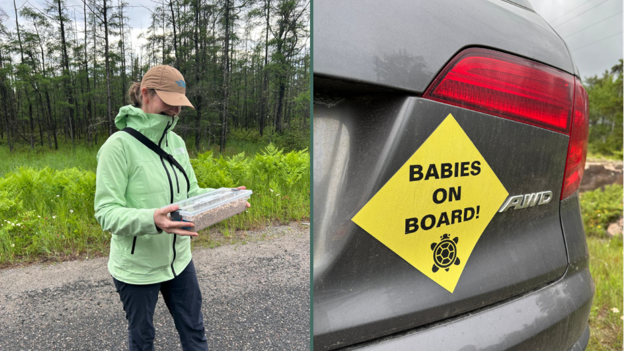
Caption: Allison Scovil, Conservation Linkage Associate at the Wilder Institute, carrying collected turtle eggs back to the car during egg collection for head-starting.
I look forward to the day these eggs begin to hatch and to seeing MFN release the hatchlings back into the wetlands close to where they were laid. With all turtle species in Ontario considered at risk and knowing that very few turtle eggs survive long enough to become nesting adults themselves, it was incredible to watch such dedicated and passionate people working tirelessly to help strengthen turtle populations in this beautiful landscape.
That day has now arrived. On August 18, MFN Elders blessed the young hatchlings, and the MFN team began releasing this season’s hatchlings into wetland habitats, the next step in a journey that started with the eggs Allison helped collect back in June. Members of the MFN community and Wilder Institute staff gathered to witness the release, bringing the turtles’ journey full circle.
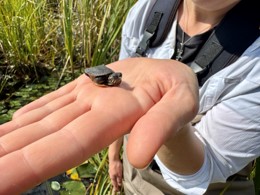
Caption: A midland painted turtle hatchling about to be released on Magnetawan First Nation Traditional Territory in August 2026.