

After nearly an hour of searching, and with only enough fuel remaining for one final helicopter pass, the team finally spotted their targets: two bright white adult whooping cranes and their remarkably well camouflaged chick. In the rain and mist, the helicopter touched down and the team sprang into action, pushing as quickly as possible through dense, soaking-wet dwarf birch shrubs to carefully catch and band the chick.
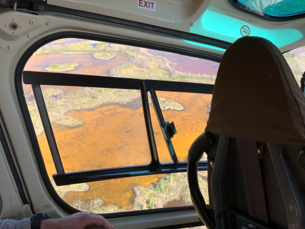
Photo caption: Can you spot the whooping cranes? View from the helicopter when looking for cranes to band in a previous year.
In August, Dr. Sandie Black and Valerie Edwards, members of the Wilder Institute’s Animal Care, Health, and Welfare (ACHW) team, joined partners Mark Bidwell and John Conkin from Canadian Wildlife Service (CWS) and Nicolas Comerford and Jordan Beer from Parks Canada for four days of whooping crane chick banding and research activities in and near Wood Buffalo National Park. Hatched in late May and early June, the chicks had ventured out from their nests but had not yet learned to fly, making August the ideal window to handle them and fit them with bands and trackers.
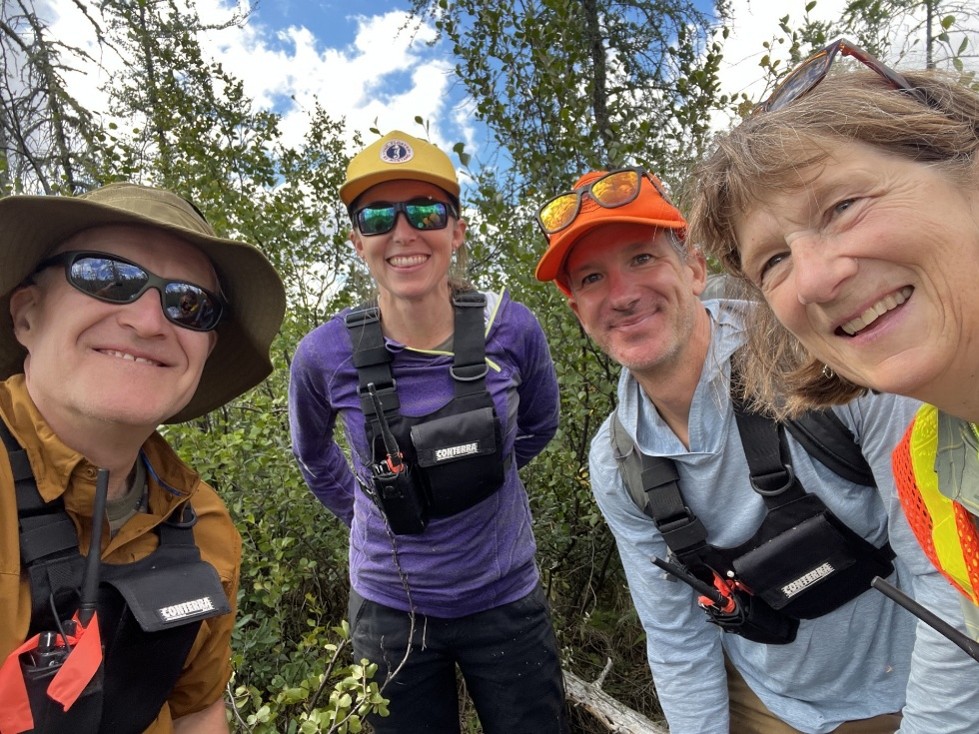
Photo caption: Some of the team participating in the banding and research activities. L-R: Mark (CWS), Valerie (Wilder Institute), John (CWS), and Sandie (Wilder Institute).
The work is part of the Whooping Crane Tracking Partnership, a collaborative effort involving CWS, Parks Canada, the U.S. Fish and Wildlife Service, and the U.S. Geological Survey that Wilder Institute staff members have supported with veterinary and handling expertise since 2017. By fitting chicks with GPS transmitters and coloured leg bands, researchers can follow their movements, behavior and survival throughout the annual cycle. Biological samples collected by Wilder Institute Senior Veterinarian, Dr. Sandie Black also provide valuable information about the health of wild whooping cranes and support surveillance for Highly Pathogenic Avian Influenza (HPAI).
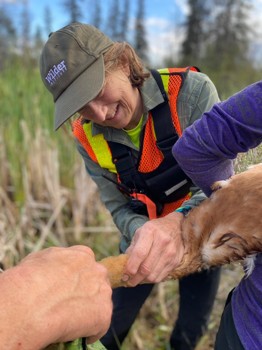
Photo caption: Dr. Sandie Black, Wilder Institute Senior Veterinarian, collecting a blood sample to support monitoring the health of the whooping cranes.
This year marked a milestone: 20 chicks were successfully captured and fitted with GPS transmitters, the first time all 20 available bands have been deployed in a single season. Two additional chicks were also safely caught and assessed but were below the weight threshold for a transmitter. This year, in another first, a chick from the Lobstick creek/Foxholes nesting area on Salt River First Nation land was banded. In honour of his late wife, the chick was later named “Chickie” by Ronnie Schaefer, a Salt River First Nation member and longtime crane observer.
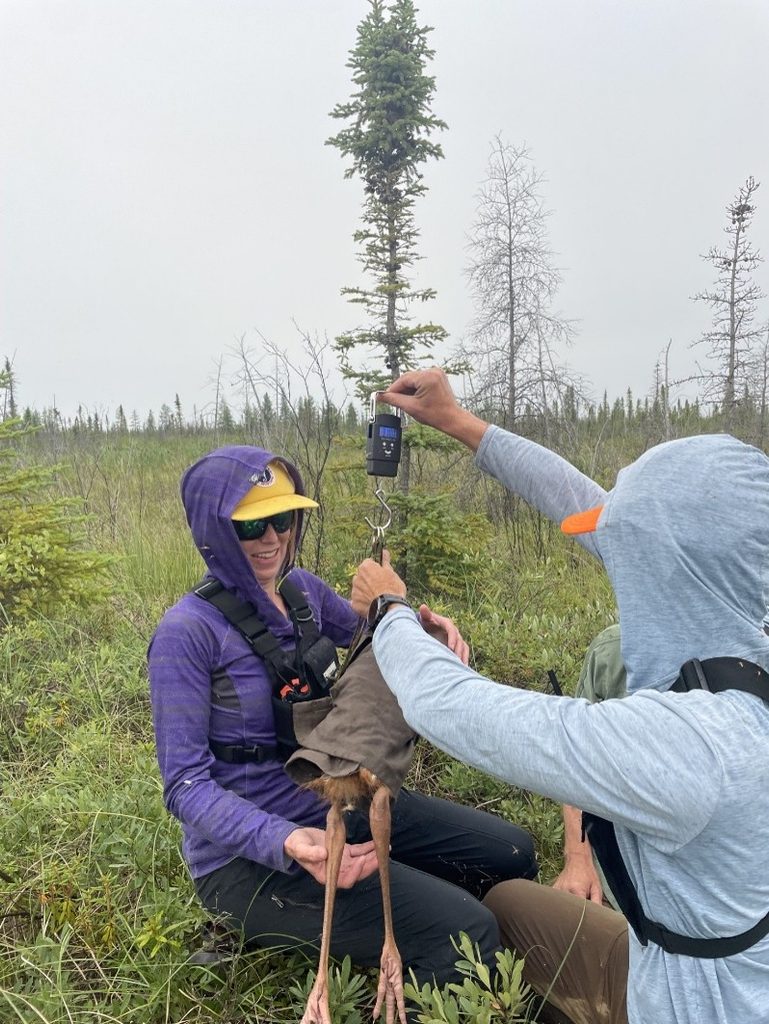
Photo caption: The team weighing a whooping crane chick.
Getting the job done is no small feat. Once a chick is spotted from the helicopter, the pilot must position the aircraft so the ground team can reach and catch the bird within a strict 12-minute window. The team then works to process the bird within 20 minutes of it being caught. Over four days, the team completed 22 successful runs, navigating everything from dense dwarf birch to thigh-deep muck.
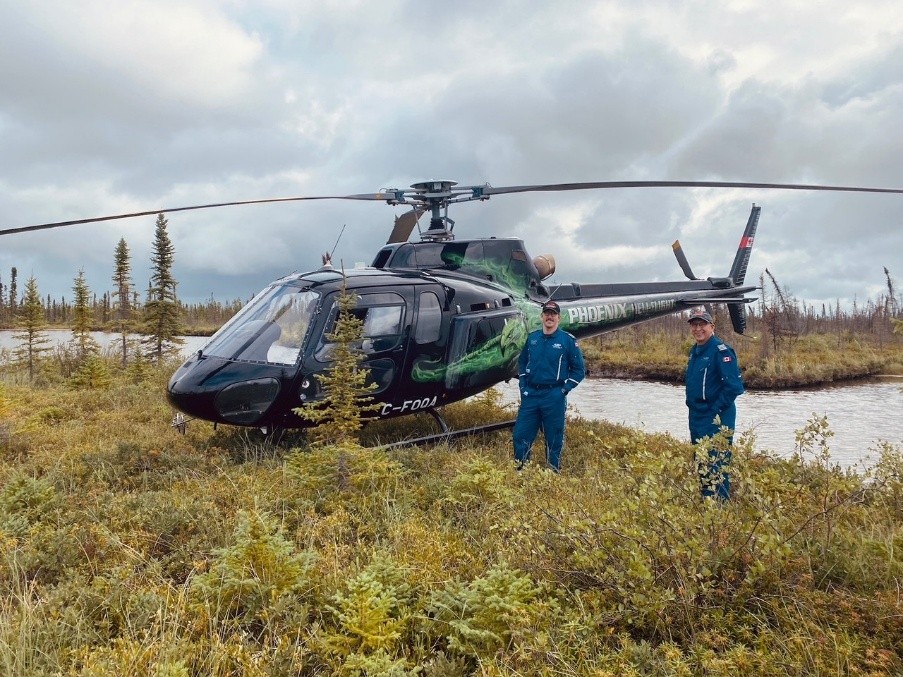
Photo caption: Phoenix Heli-Flight Inc.’s Paul and Cameron provided expert piloting to get into hard to access locations.
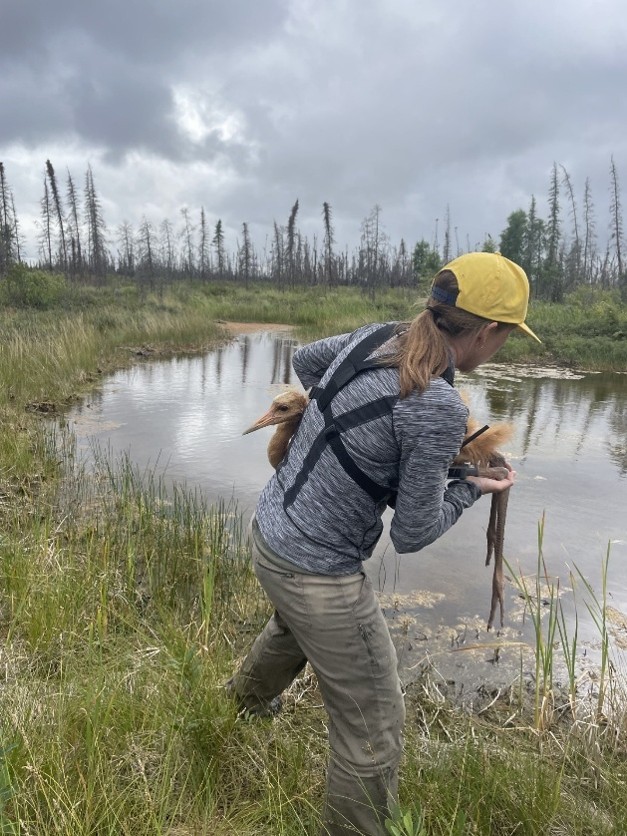
Photo caption: Valerie Edwards, member of the Wilder Institute’s Animal Care, Health, and Welfare team carefully handling a whooping crane.
There were plenty of memorable moments. The team found the northernmost whooping crane pair and their chick near the shore of Great Slave Lake, and they watched chicks disappear into the cattails away after release, hearing their soft contact calls as they reunited with their parents. The team also got to see a landscape that few people get to see, including the beautiful colours of pink fireweed, deep green boreal forest, bright green lichens, and emerald blue lakes.
Behind every successful banding was extraordinary teamwork. Expert helicopter piloting by Phoenix Heli-Flight Inc.’s Paul Spring, skilled field handling by Valerie, veterinary care by Sandie and careful measurements and a deep knowledge of the landscape by Mark, John, Nic, and Jordan made for a very successful banding year. Together, the team gave 20 young whooping cranes a tiny piece of technology that will help tell their story for years to come.
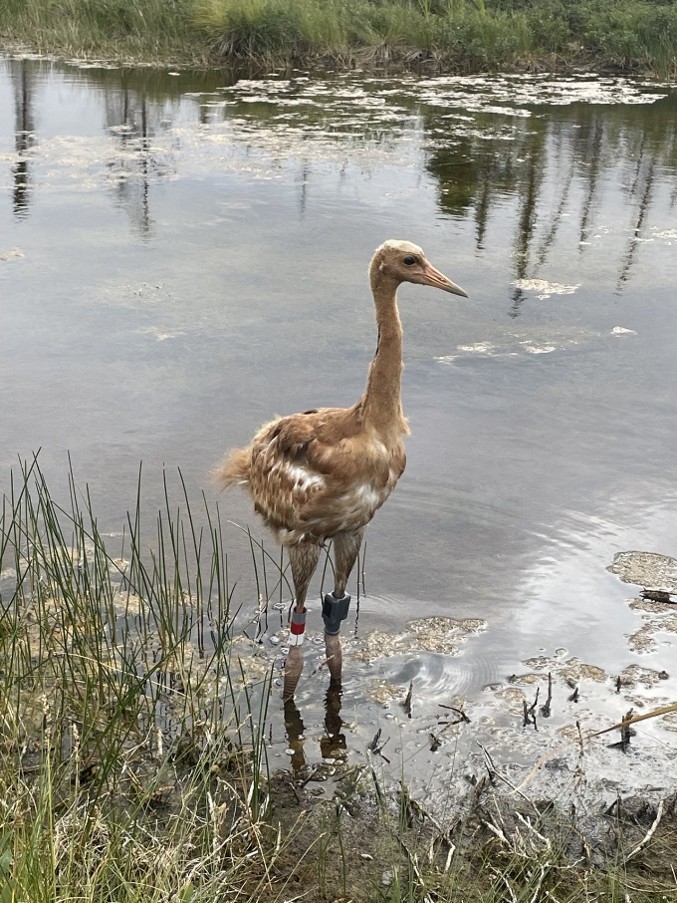
Photo caption: A whooping crane, now equipped with bands and a GPS transmitter, released back into the wetland.